
Why the Follow Gate Checks After It Sends
The failure nobody explains
You set up the classic lead magnet. Post a reel, tell people to comment a keyword, and the tool DMs them the guide. Then you add the growth step everyone recommends: make them follow you first. Deliver the file only to followers, and the same reel that collects emails also collects followers.
Then it behaves strangely. Some people get the file instantly and were never following you. Some get told to follow, follow immediately, and never hear from you again. Some get nothing at all. The dashboard says every automation fired successfully.
Almost every article about follow gates is about whether you should use one. Growth tactic, ethics of gating, does it hurt your reach. All of it assumes the mechanic itself is simple: look up whether they follow you, then branch. That assumption is the bug. On Meta's official API you cannot look up whether a commenter follows you, because at the moment they comment you do not yet have permission to ask. And you do not get a second chance to send, because a comment buys you exactly one message.
Every strange behaviour above falls out of those two rules.
First principle: a comment is not consent
There is exactly one sanctioned way to learn whether an Instagram user follows your account: the Instagram User Profile API. Given an Instagram-scoped ID, it returns name, username, profile_pic, follower_count, is_user_follow_business, is_business_follow_user and is_verified_user. The field you want is is_user_follow_business, which Meta defines as indicating "whether the Instagram user follows your app user (true) or not (false)".
It also has a precondition, and the precondition is the whole story:
"User consent is set only when an Instagram user sends a message to your app user, or clicks an icebreaker or persistent menu."
And the ID you pass is not any ID you happen to have. Meta specifies it is the Instagram-scoped ID received from a webhook notification, from the messages.sender.id property of a messaging webhook.
A comment does not produce a messaging webhook. Comments arrive on the comments field, which is a different subscription requiring a different permission (instagram_business_manage_comments) from the one messaging uses (instagram_business_manage_messages). Someone who comments GUIDE on your reel has done nothing that sets consent. They are, as far as the profile endpoint is concerned, not addressable.
So the sentence "check whether the commenter follows you, then decide what to send" describes an operation the platform does not offer. Not rate-limited, not gated behind review. It does not exist in that order.
The second rule: one private reply, and that is all
The way a comment becomes a DM is the private reply: you send a message with the comment_id in the recipient object rather than a user ID. Meta's rules on it are short and absolute.
| Rule | Meta's wording |
|---|---|
| How many | "Only one message can be sent to the commenter" |
| By when | "The message must be sent within 7 days of the comment was made on the post or reel" |
| What comes next | "Follow-up messages can only be sent if the recipient responds, and must be sent within 24 hours of the response" |
| Live video | "For Instagram Live, private replies can only be sent during the live broadcast. Once the broadcast ends, private replies cannot be sent" |
Read those together with the consent rule and the design space collapses to one shape. You have a single message to spend on a person you know nothing about. Nothing about them becomes knowable until they answer that message. And once they answer, a 24-hour clock starts.
The obvious follow gate wants two messages: one that says "follow me first" and one that delivers the file. There is no second private reply. If you spend your one message on the gate, the only route left to the file is the user replying to you, which is now a thing you have to earn rather than a thing you can trigger.
The sequence that actually works
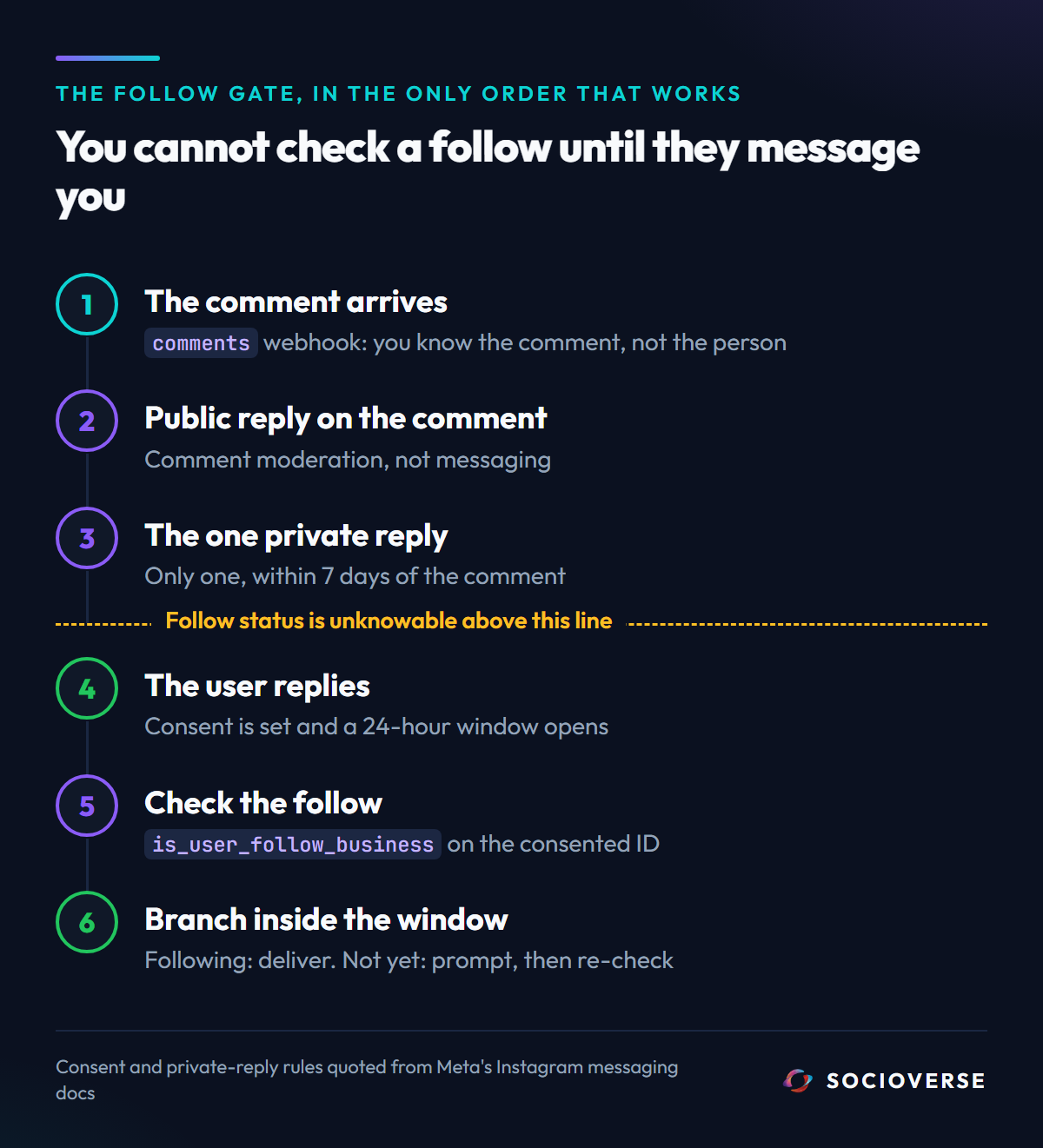
Once you accept that the check happens after the send, the correct flow writes itself:
- The comment arrives on the
commentswebhook. You know the comment, the media and the text. You do not know the person. - Public reply, on the comment surface. Replying publicly to the comment is comment moderation, not messaging, so it does not consume anything from the messaging budget. It is also the social proof half of the play.
- The one private reply fires, addressed to
comment_id. This message has to do two jobs at once: state the follow ask, and give the user a reason to reply that is more attractive than closing the app. - The user replies. This is the moment everything changes. It is a messaging webhook, so now there is a
messages.sender.id, consent is set, and a 24-hour response window is open. - Now you check. Call the User Profile API on that Instagram-scoped ID and read
is_user_follow_business. - Branch, inside the window. Following, deliver the asset. Not following, send the prompt and schedule a re-check, because their follow can land after your message and the answer changes underneath you.
The gate is real. It just sits one step later than everybody draws it. The reply is not a formality on the way to the check; the reply is the thing that makes the check legal.
That single displacement explains all three symptoms from the top of this post. The instant delivery to a non-follower is a tool that never checked, because at that moment it could not have. The user who follows and then hears nothing is a flow that spent its one private reply on the ask and had no way back in. The silent failure is usually a comment that aged past seven days, or a reply answered outside the 24-hour window.
Three ways this gets built wrong
1. Burning the private reply on the gate. "Follow me and comment again" is the most expensive sentence in Instagram automation. It uses the single message on an instruction, and the second comment is a fresh comment with a fresh comment_id, so a tool built this way can technically send again. It is also asking a stranger to do two things before receiving anything, at the exact point where attention is cheapest to lose. The ask and the payoff path belong in the same message.
2. Faking the check by reading the follower list. There is no official endpoint that hands you an arbitrary user's follow relationship without consent, so a tool that reports follow status the instant a comment lands is getting it somewhere else. That somewhere else is the app: a logged-in session, a headless browser, a scraped follower list. This is not a grey area. It is the same category of behaviour that gets accounts restricted, and we have written up the documented ban vectors and the error codes involved in Instagram DM automation without getting banned. A follow gate is not worth an account.
3. Retrying into a wall. When the second private reply fails, the naive handler treats it like a flaky network and retries. Meta is explicit about the cost:
"When the limit has been reached, stop making API calls. Continuing to make calls will continue to increase your call count, which will increase the time before calls will be successful again."
The throttling codes are documented: 4 (app-level limit), 17 (user-level limit), 32 (Pages API limit) and 613 (a custom rate limit). A refusal that is structural, like a second private reply on the same comment, will never succeed on retry. Treating it as transient converts a design error into an account cooldown.
What you can know, and when
The clearest way to hold this in your head is as two columns.
| A user who commented | A user who messaged you | |
|---|---|---|
| Identity available | Comment ID, comment text, the media it landed on | Instagram-scoped ID from messages.sender.id |
is_user_follow_business |
Not available | Available |
follower_count, username, is_verified_user |
Not available | Available |
| Messages you may send | One, within 7 days | Follow-ups within 24 hours of their response |
| Webhook field | comments |
messages |
| Permission | instagram_business_manage_comments |
instagram_business_manage_messages |
Every follow gate feature in every tool on the market is built inside that table. The tools differ only in whether they respect it.
How Socioverse builds it
The Smart Follow Gate is a conversion layer on top of a comment automation, and it is arranged around the sequence above rather than against it.
- Public reply and private DM fire together off the comment trigger, so the social proof and the one private reply both land without a second round trip.
- Randomised delay support, configurable from 5 to 60 minutes, spaces the response instead of firing a metronome into Meta's abuse detection.
- The follow check runs on the consented ID, at the point where the user has actually replied and the profile endpoint will answer.
- Not following gets a prompt, and a re-check is scheduled after a delay, because someone who taps Follow ten seconds after your message would otherwise be permanently classified as a non-follower by a single lookup.
- Delivery comes from the Asset Bank: a link, a PDF or a video attached to the automation, so the payload is a stored object rather than something assembled at send time.
- A DM sequence can attach after the trigger for the multi-day nurture, and a "STOP" reply halts it automatically.
- The lead lands in the Lead Bank tagged with the source automation and a pipeline stage, which is the only reason any of this was worth doing.
Underneath, every outbound call runs through the same queue, per-account spacing and error interception described in the DM automation post. A structural refusal is recorded as final. A throttle is backed off by its code. Neither is retried into a restriction.
Is a follow gate worth it at all
Honest answer: it depends on the asset, and we are not going to hand you a conversion percentage for your account, because we have not run it on your account and neither has anyone quoting you one.
What the mechanism does is fixed and knowable. A follow gate trades speed of delivery for a follow. Every step you insert between the comment and the file loses some people. Some assets are worth that friction and some are not. A genuinely useful thing that the person came looking for survives an extra tap. A generic PDF that was really a pretext for the DM does not, and gating it just converts a soft lead into an annoyed one.
The engineering argument is narrower than the growth argument and more reliable: whatever you decide to gate, the gate has to be built in the order the platform permits. Built in the order the tactic articles imply, it either silently does nothing or quietly puts the account at risk.
Frequently asked questions
Can any tool check whether someone follows me before it DMs them?
Not through Meta's official API. Follow status comes from the Instagram User Profile API, and Meta sets consent for that endpoint only when the user sends a message, clicks an icebreaker, or uses a persistent menu. A comment does not qualify. A tool that reports follow status at comment time is reading it from somewhere Meta did not sanction.
Why did my follower never receive the file after they followed?
Most likely the automation spent its single private reply on the follow instruction. Meta allows one message per comment, so unless that person replied to you and reopened the thread, there was no legal way to send the file. The fix is to put the ask and the delivery path into the same message.
How long do I have to respond to a comment?
Seven days from when the comment was made, for the private reply. Once the user responds, follow-ups must go out within 24 hours of that response. Instagram Live is stricter: private replies only work while the broadcast is running.
Does a follow gate hurt my account safety?
The gate itself is fine. It is a message sent in response to a user action, through the official messaging API. The risk comes from implementation: scraping follower lists to fake the pre-check, sending byte-identical text at volume, or retrying refused calls until an app-level or user-level rate limit trips.
Do I need the follow gate to capture the lead?
No. The comment automation captures the lead either way, and the follow gate is an optional layer on top. It is worth turning on when the asset is strong enough to survive one extra step, and worth leaving off when it is not.
Sources and references
Meta developer documentation was fetched and quoted directly on August 21, 2026, except where noted.
- Instagram User Profile API, field list and the consent rule ("User consent is set only when an Instagram user sends a message to your app user, or clicks an icebreaker or persistent menu"), and the requirement that the Instagram-scoped ID comes from a messaging webhook: developers.facebook.com - Instagram User Profile API
- Private replies: one message per commenter, the 7-day comment window, the 24-hour follow-up window, the
comment_idrecipient, and the Instagram Live restriction: developers.facebook.com - Private Replies - The 24-hour messaging window ("Your app has 24 hours to respond to any message sent from an Instagram user to your app user"): developers.facebook.com - Instagram Messaging API
- Webhook fields and their permissions (
commentsrequiresinstagram_business_manage_comments,messagesrequiresinstagram_business_manage_messages): developers.facebook.com - Instagram Platform Webhooks - Rate limiting guidance and throttling error codes 4, 17, 32 and 613: developers.facebook.com - Rate Limiting
- Meta Community Standards on Spam, quoted in our earlier post and accessed June 15, 2026: transparency.meta.com - Spam
- Socioverse: pricing, follower growth, DM automation