
Safe Instagram DM Automation Guide
If you have read horror stories about creators losing their Instagram accounts to automation tools, your caution is justified. Several popular comment-to-DM platforms have triggered waves of restrictions - not because automation itself is against the rules, but because those tools were built without respecting how Meta's documented limits and abuse-detection systems actually work.
Socioverse is a Meta-verified application that sends every message through the official Instagram API with Instagram Login. But verification alone does not protect a user - the software around the API has to be engineered for safety. This article breaks down the ban vectors Meta documents, and the specific engineering Socioverse uses to neutralize each one.
Every Meta-attributed claim below is taken directly from Meta's own developer documentation and Community Standards, quoted and linked in Sources, accessed June 15, 2026.
First Principle: Official API, Not App Automation
A major reason creators get restricted is using tools that automate the Instagram app (browser bots, mobile emulators, session-token scrapers) instead of the sanctioned API. Meta provides an official Instagram messaging API designed exactly for this use case, with permissioned, token-based access.
Socioverse never touches your login. It connects through the official Instagram API with Instagram Login (OAuth), using encrypted, scoped access tokens, the way Meta's platform is designed to be used. There is no password sharing, no session hijacking, no headless browser pretending to be your phone. That alone separates Socioverse from the category of tools that get accounts wiped.
The Documented Ban Vectors (and How We Close Each One)
1. Velocity Spikes and Rate Limits
What Meta documents: The Graph API enforces application-, user-, and page-level rate limits. Crucially, Meta's rate-limiting guidance states: "When the limit has been reached, stop making API calls. Continuing to make calls will continue to increase your call count, which will increase the time before calls will be successful again." It also recommends checking the X-App-Usage header and spreading queries evenly rather than firing them in spikes.
How Socioverse prevents it:
- Per-account velocity smoothing. Every connected Instagram account gets its own scheduled "send slot." Outbound DMs are spaced apart automatically so an account never fires a sudden burst, even if a reel goes viral and thousands of comments arrive at once.
- Algorithmic jitter, not flat delays. Spacing is randomized (a base interval plus a random offset), not a fixed metronome.
- Account isolation. One creator's viral moment can never starve or accelerate another's queue.
- Idle fast-path. If you are not in a burst, replies still go out near-instantly. The smoothing only engages when volume actually spikes - exactly when Meta's guidance says to slow down.
2. Ignoring Rate-Limit Backpressure (the silent account-killer)
What Meta documents: When you hit a limit, the API returns specific throttling error codes. Meta defines them as:
| Code | Meta's definition | Socioverse's response |
|---|---|---|
| 4 | The app whose token is being used has reached its rate limit | Pause all sending globally for 15 minutes |
| 17 | The user whose token is being used has reached their rate limit | Cool that account down for 1 hour |
| 32 | The user or app has reached its rate limit on the Pages API | Pause that account for 30 minutes |
| 613 | A custom rate limit has been reached | 1-hour back-off for that account |
The danger is not the limit itself - it is the retry loop. Meta is explicit that continuing to call a throttled endpoint increases the time before calls succeed again. Cheap automation tools treat a rate-limit error like a flaky network and retry in a loop, which is what turns a short cooldown into a long or permanent restriction.
How Socioverse prevents it: Socioverse runs every outbound call through a Meta error-interception engine that reads the exact error code and responds with the correct back-off (per the table above) instead of retrying blindly. A temporary block is treated as a stop sign, not a network blip.
3. Identical-Text Fingerprinting (the spam signal)
What Meta documents: Meta's Community Standards on Spam prohibit acting "either manually or automatically, at very high frequencies," and content "designed to deceive, mislead, or overwhelm users in order to artificially increase viewership." The policy also warns that Meta "may place restrictions on accounts that are acting at lower frequencies when other indicators of Spam ... or signals of inauthenticity are present." Sending the exact same block of text to many unique users is a classic inauthenticity signal.
How Socioverse prevents it:
- Native Spintax engine. Creators write one template with variations -
{Hi|Hey|Hello} {first_name}, {grab|check out} your link- and Socioverse renders a structurally different message for every recipient. No two DMs are byte-identical. - Real personalization. First name, username, and contextual variables are merged per recipient.
- First-time-only and cooldown controls. Built-in filters prevent messaging the same user repeatedly, and per-automation cooldowns enforce gaps between contacts.
4. Dangerous Links and Shared-Domain Reputation
What the tooling documents: Google Safe Browsing is a service that "lets client applications check URLs against Google's constantly updated lists of unsafe web resources" - phishing and social-engineering sites, malware-hosting pages, and unwanted software. (Google's Web Risk API is the equivalent intended for commercial use.) For a platform hosting many creators, one bad outbound link can damage the reputation of the shared root domain.
How Socioverse prevents it:
- Pre-flight link scanning. Every URL a creator adds - in a DM button, a saved link, or a Planets storefront block - is checked against Google's Safe Browsing threat lists before it can go live.
- Send-time verification. Outbound DM links are re-checked at send time, so a link that turns malicious later is caught before it reaches anyone.
- Automatic containment. A link flagged as dangerous is quarantined and the offending automation is disabled, so one bad link can never repeat across thousands of sends.
- Fail-open by design. Scanning never blocks a legitimate creator because the scanner was slow - only a confirmed unsafe verdict stops a link.
5. The 24-Hour Messaging Window
What Meta documents: Instagram's messaging API gives an app "24 hours to respond to any message sent from an Instagram user to your app user." For longer cases, Meta provides the human_agent tag, which "allows your app to have a human agent respond to user messages ... within 7 days of a user's message" - intended for support cases that cannot be resolved in the standard window.
How Socioverse prevents problems:
- Window-aware sending. Socioverse sends within Instagram's allowed messaging window and treats an "outside the window" response as a permanent, non-retried outcome rather than hammering a closed window.
- Comment-triggered, consent-based flow. Automations fire in response to a user's own action (a comment or DM), the consent-based interaction the messaging API is built around.
The Architecture Behind It
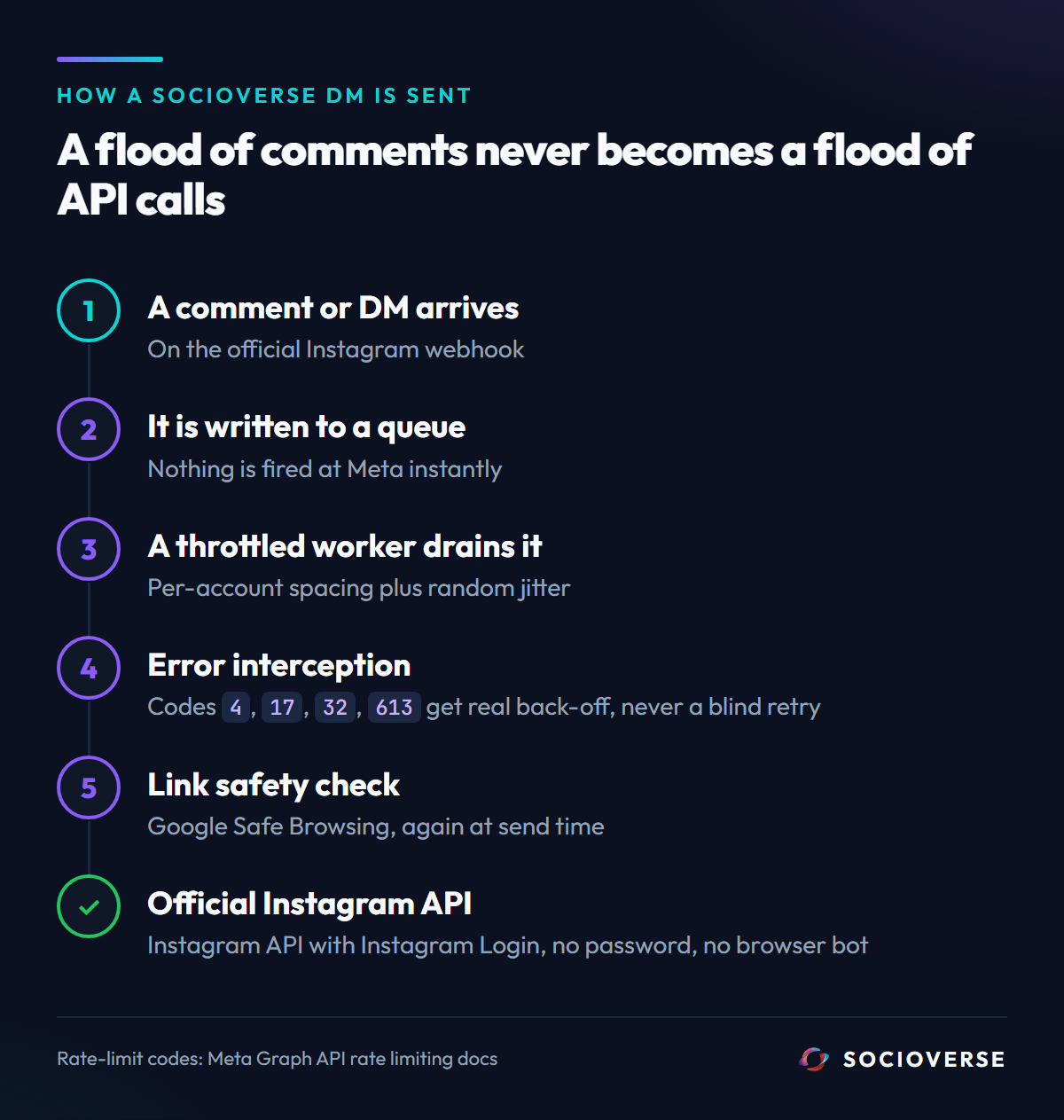
None of this is a bolt-on. Socioverse is built as an active mediator between Instagram and your account:
- A comment or DM hits the official webhook.
- The trigger is written to a decoupled queue - nothing is fired at Meta instantly.
- A throttled worker drains the queue at a human pace, with per-account spacing and jitter.
- Every call passes through the error-interception engine and link-safety layer before it reaches the Instagram API.
Because sending is decoupled from triggering, a flood of comments can never become a flood of API calls. The queue absorbs the spike; the worker releases it safely.
Frequently Asked Questions
Can Instagram automation get my account banned?
It can - if the tool automates the app instead of the API, ignores rate limits, or sends identical spam. Tools that use Meta's official API, respect the documented rate-limit behavior, and follow the anti-spam rules are far safer. Socioverse is engineered specifically around those rules.
Is Socioverse approved by Meta?
Yes. Socioverse is a Meta-verified application and uses the official Instagram API with Instagram Login. It never asks for your Instagram password or automates the app through a browser or emulator.
What makes Socioverse safer than other comment-to-DM tools?
Four engineering layers many tools skip: per-account velocity smoothing with randomized jitter, a Meta error-interception engine that backs off correctly instead of retrying into a restriction, a spintax engine that prevents identical-text spam signals, and Google Safe Browsing link scanning that protects domain reputation.
Will my DMs send instantly?
For normal traffic, yes - replies go out near-instantly. The velocity smoothing only spaces messages when volume spikes (a viral reel), which is exactly when unthrottled sending would get you flagged.
Do I still need to follow good practices?
Yes. Use varied call-to-action keywords (prefer "SEND DETAILS" over a generic "LINK"), keep 2FA enabled on your Instagram account, and avoid mass-messaging people who never engaged with you. Socioverse nudges you toward these inside the product.
Sources and References
All Meta-attributed quotes were taken from the following pages, accessed June 15, 2026.
- Graph API rate limiting and throttle error codes 4, 17, 32, 613 (and the "stop making API calls" guidance): developers.facebook.com - Rate Limiting
- Instagram 24-hour messaging window and the human_agent tag: developers.facebook.com - Instagram Messaging API
- Meta Community Standards - Spam ("manually or automatically, at very high frequencies"; inauthenticity signals): transparency.meta.com - Spam
- Google Safe Browsing (URL threat checking; Web Risk for commercial use): developers.google.com/safe-browsing
- Socioverse: socioverse.io